Saturday, July 9, 2011

Sleazy Noir Music Contest...


"If you wanna save souls, you can't keep on preachin' to the choir. You got to go OUT in the world and testify."
Yeah, but I'm quite comfortable here on the sofa, and so instead... Pointless contest time.
Actually, it’s not completely pointless—just drumming up interest in my novel, The Bastard Hand.
You in?
Here’s the deal: I have three copies of the novel in trade paperback, ready to fly through the mail and into your grubby little fingers. I’ll even sign ‘em for you, just so you can proudly say you have a personally autographed copy of The Bastard Hand (and folks will look at you with either envy or complete apathy).
What you need to do:
1. “Follow” Psycho-Noir. Yeah, that little button over there on the right. No, the other right.
2. Tell me what you think is the absolute BEST song ever for reading sleazy, morally reprehensible crime fiction.
3. (and this one is kinda important for my nefarious purposes) Maybe tell some other folks (re-tweet, re-post, re-gurgitate, whatever) about how The Bastard Hand changed your life, gave you hope in a hopeless world, a better credit score, etc….
That’s it. That’s all you have to do. On July 16th, a week from today, I’ll randomly select THREE winners (I say random, because if your taste in music sucks it shouldn’t be counted against you, right?), announce them, and send those bad boys out.
So what are you waiting for? Let the musical chaos ensue!

Wednesday, July 6, 2011

Hardboiled/Noir Writers Part 2


Part 1, here.

The first hardboiled detective story is usually credited to a guy named Carroll John Daly, which is unfortunate because Daly was kind of a lousy writer. But he more or less invented the hardboiled detective with his character Terry Mack, in the May 1923 issue of Black Mask.

The story was called “Three Gun Terry”, and it wasn’t too much different than the old Nick Carter stories except that the hero was every bit the nasty equal of his nemesis. He wasn’t afraid to get his hands dirty; he knew the streets, he knew the lingo, he was a wise-ass and a bad-ass, and the readers of Black Mask fell immediately in love with him.

Daly also created the character Race Williams just a couple of months later in the story “Knights of the Open Palm”; Race was pretty much the same thing as Terry Mack but soared to even greater heights of fame amongst Black Mask readers.

The stories that Daly wrote were invariably cookie-cutter stuff, predictable, violent, low-brow. If you stalk the used bookstores or E-bay, you might be able to find paperback editions of the stuff he wrote for Black Mask, like The Hidden Hand or The Tag Murders. They don’t stand up well now, and even then more sophisticated readers rightfully dismissed him and this new unpleasant style of detective story that seemed to cater to the lowest common denominator.

And yet, in a 1930 poll, Black Mask readers voted Daly their favorite. Dashiell Hammett was a distant second. Fortunately, time has rectified that misjudgment.

Dashiell Hammett’s first story of the Continental Op appeared in Black Mask in the October 1923 issue, only months after Daly’s first Race Williams story, and signified a serious change in the demeanor of hardboiled. The most significant difference between Hammett and his hardboiled predecessor was a simple one: Hammett could write. He could really write. He used short, declarative sentences, designed for maximum effect; he didn’t spend much time inside the head of his protagonist; he concentrated on keeping the story moving, and practically invented the idea of “real time” action. Hammett was a revelation.

Every hardboiled detective since the Op owes its existence to Hammett. He transformed what might have turned out to be a literary fad into a genuine movement that’s still going strong today, and redefined what we think of as the “American voice” in fiction.

Hammett brought to the table his experiences as a private detective for the Pinkerton agency, and that experience colored all his work, but especially the stories of the Op. Later, he would create the memorable Sam Spade in a series of stories and the novel The Maltese Falcon, but for me it’s all about the Continental Op—short, mulish, fat, and totally dedicated to the job. The Op is a relentless, unstoppable force that has no existence outside his job. He’s incorruptible not because it would be immoral to break his own rules but because it would be unprofessional.

Hammett’s work has never been out of print in the States, and if you’re new to the genre there’s no excuse not to start with the source. He wasn’t amazingly prolific. He wrote all of his great work in a short ten year period, and in the last twenty years of his life didn’t write a single word that saw publication.

All of his books with the exception of The Thin Man were first serialized in Black Mask. They are:

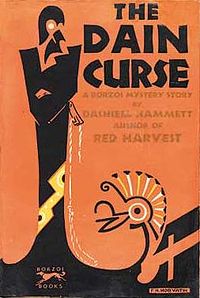
The Dain Curse
Red Harvest
The Maltese Falcon
The Glass Key
The Thin Man
…and his short stories are collected in these editions from Black Lizard/Vintage Crime:
The Big Knockover
The Continental Op
Nightmare Town


The 1920’s and early ‘30’s were the Golden Age of the Hardboiled novel. Following in the wake of Hammett, hardboiled dicks started springing up all over the place. Most of them were pale imitations, adding nothing significant to the genre, but occasionally someone would come along with a fresh game and slap things around a little.

Fans of the detective story will often refer to the Holy Trinity of Hammett-Chandler-Cain, as if these three writers had anything in common. You’ve seen the reviews of every new detective novel, referring to this or that new writer as being “in the best tradition of Hammett, Chandler and Cain”. In reality, they couldn’t have been more different from one another, not only in style but in subject matter. It’s like saying, “In the best tradition of Shakespeare, James Fenimore Cooper, and Stephen King”.


Raymond Chandler certainly utilized the raw materials that Hammett made, but he represented the next phase of the hardboiled story and took the genre in a new direction, one of rich, evocative language and something a little closer to a genuine literary agenda. Reading about Chandler, you almost get the idea that he was insecure in his chosen field, that he feared more than anything not being taken seriously as a writer. He shouldn’t have worried; his reputation as a literary giant is intact, despite the hundreds of pastiches of his work that have surfaced over the decades.

“He was about as inconspicuous as a tarantula on a slice of angel food cake.” All those brilliant and fun metaphors that we’ve come to associate with his novels about Philip Marlowe were only the bells and whistles. On a deeper level, Chandler was struggling with bigger themes of decency, humanity, and how to maintain a moral stake in a world where morality has no place. That was something his imitators never understood.

What can you say about Chandler that hasn’t already been said? While not as tight a plotter as Hammett, Chandler’s voice as a writer was sharp and observant, and his style was hugely influential. Like Hammett, Chandler wasn’t prolific; he wrote only seven novels in his lifetime, and only the first four or five of those were notable.

The Big Sleep
Farewell, My Lovely
The High Window
Lady in the Lake
The Little Sister
The Long Goodbye
The Simple Art of Murder


Mentioning James M. Cain in direct reference to the other Gods of the Trinity is especially inaccurate; Cain didn’t write about detectives, and he certainly didn’t write about characters of high moral standing. In that regard, he was one of the first writers that we can actually call noir.

Chandler hated him. He thought Cain was a filthy pervert, celebrating everything indecent about humanity. To some extent he was right. But what Chandler failed to see was that Cain understood the darkness in our souls, the lengths humans are willing to go to in order to avoid their own doom, and the knowledge that it was futile anyway; we are all doomed, and every step we take to change that brings us that much closer to the end.

Cain was a poet of entropy, and from his novels came noir, fully formed. The hapless protagonist, lured by sex, the manipulative femme fatale, the raw sexuality, the violence, and the wicked plan that’s doomed from the start. Reading his novels—especially the first two—gives the reader a crash course in noir that covers all the basics.

Double Indemnity
The Postman Always Rings Twice
Serenade
Root of His Evil
The Embezzler
Mildred Pierce
Love’s Lonely Counterfeit


Albert Camus is quoted as saying his novel The Stranger was inspired in part by Cain’s The Postman Always Rings Twice. So what’s the difference between noir and existential? You tell me. I believe The Stranger more than qualifies as noir.


A contemporary of Hammett, Chandler and Cain’s was the remarkable W.R. Burnett. He too brought something new to the hardboiled table, something midway between Chandler and Cain—instead of focusing on the detective-hero or the hapless sucker, his central characters were usually straight-up bad guys: gangsters, thieves, etcetera. He was hugely popular for awhile, especially in the ‘30’s when Americans began to glamorize the crooks of Prohibition and the roaming bank robbers like John Dillinger. Burnett’s timing couldn’t have been better. Of course, the bad guy heroes of his stories always paid the piper at the end. Noir hadn’t developed so much that the bad guy could get away with his crimes—that development was a couple of decades away.

Little Caesar
Iron Man
Dark Hazard
High Sierra
The Asphalt Jungle
Nobody Lives Forever

There were other writers who don’t get referenced as often as Hammett, Chandler, Cain or even Burnett who still made important contributions and added their own particular ingredients to the ever more diversified genre of hardboiled/noir.

One of the greatest and most underappreciated was Horace McCoy, who wrote what is perhaps the most grueling noir of the ‘30’s, They Shoot Horses, Don’t They? There are no private dicks here, or gangsters or even hapless sex-slaves. It takes place during a brutal dance marathon—a popular past-time of the era—and uses the marathon as a perfect metaphor for the unrelenting cruelty of existence. It’s a harsh, uncompromising book. His others were almost as good.

They Shoot Horses, Don’t They?
No Pockets on a Shroud
Kiss Tomorrow Goodbye
I Should’ve Stayed Home


Eric Knight, writing under the name Richard Hallas, gave us one notable book that has taken on a sort of Holy Grail-like quality. It’s highly-regarded by fans of noir but is rarely read these days—in fact, since the decades since its first appearance it’s been out of print most of the time. Black Lizard was the last to reprint it, back in the ‘80’s. But its well-worth searching out.

You Play the Black and the Red Comes Up


Paul Cain is another lost master of noir. He wrote a handful of short stories, collected later into one volume, and one novel that Raymond Chandler called “some kind of high-water mark in hardboiled”. Fortunately, his meager output is still available in an omnibus edition.

Fast One
Seven Slayers


And Raoul Whitfield deserves to be mentioned for a number of reasons: he was one of Black Mask’s most prolific contributors for awhile, he created the first Filipino detective hero (Jo Gar), and his stories about ex-convict Mel Ourney became the highly-regarded novel…

Green Ice


There were hundreds of other writers who plied their trade in the pulp magazines throughout the ‘20’s and early ‘30’s, obviously—names that are mostly lost to us now, stories that no one will ever read again. Some of them deserved a bigger audience; most of them didn’t. Fortunately, the decades since the pulp magazine explosion have mostly seen the cream rise to the top. It was an amazing time, though. With the profusion of magazines on the stands—there were literally hundreds of them—a professional writer with a little talent and a lot of dedication could eke out a living for himself, and if he was lucky, leave behind some sort of small legacy.

Part 3 here.

Tuesday, July 5, 2011

A Disheartening Conversation...

Dude: "So you want to be a writer, eh?"

Me: "No. I AM a writer."

Dude: "I mean a PUBLISHED writer."

Me: "I AM a published writer, that's what I'm saying."

Dude: "Ah, well, self-published doesn't count, does it?"

Me: "I'm NOT self-published, man. I have a book out from an actual publisher."

Dude (frowning thoughtfully): "How come I've never heard of you, then?"

Me: "I... well, I don't know. I mean, most people haven't. It's a small press, and, um... a niche market, and all."

Dude: "Right. That's very cute."

Me: "The book has gotten very good reviews."

Dude: "Hey, we all gotta start somewhere. Don't feel bad about it."

Me: "I DON'T feel bad about it. Well, I DIDN'T, a minute ago."

Dude: "Keep following your dreams, man."

Me: "Excuse me while I go hang myself from the rafters now."

Dude: "Right on."

Monday, July 4, 2011

Peter Rabe


Just read three novels in a row from Peter Rabe. You know him? He was one of those remarkable Gold Medal writers of the ‘50’s and ‘60’s. I still maintain that those fellas (and occasional dames) were the tightest, leanest group of writers ever to walk this here planet, and every time I’m in need of inspiration, they are the scribblers I go to.

Peter Rabe, though… he was in a bit of a class by himself. Style, man, that’s what I’m talking about. He was as lean and tough-minded as any of his contemporaries, but his best work was also laced-through with a kind of vivid, hard-boiled poetry, a really unique cadence to his sentences that continuously draws a reader in and touches something indefinable inside.

Example:

“There was a cool, watery smell in the air. Jesso looked back at the row of trees, and then the villa again. He didn’t often feel like this, but suddenly it was as if he were out of place. Jesso hunched his shoulders. It sure didn’t feel like home territory. Hell, there was no more home territory. There was nothing but Jesso with a two-day beard, his stolen clothes, and a half-crazy scheme that hadn’t even begun to take shape. He rubbed his face and then he made a noise as if he meant to laugh but thought better of it. Christ, a real one-man operation. He always wanted a one-man operation, and now he had it; right in the neck he had it. Or it had him. A free hand and nobody underfoot. It had come true so completely that he didn’t know whether to laugh or to swear.”

You see what I mean? Stripped down, almost stream-of-consciousness, but still amazingly vivid and emotional. The repetition of certain words, the short, sudden sentences. It all equals powerful and involving story-telling.

The first Rabe I read was, by coincidence, his first published novel (not counting a memoir thing he wrote), Stop This Man! It wasn’t bad. The story moved along nicely, and the only real bad thing you could say about it was the somewhat idiotic and unfunny comedy relief. If you haven’t read Rabe, I really recommend you DON’T start with Stop This Man!

After that, I moved on to the Stark House double edition of Anatomy of a Killer and A Shroud for Jesso. Both brilliant in their different ways, but of the two, A Shroud for Jesso is better.

The most striking thing to me was how all three novels were completely different. Yeah, they all feel into the crime fiction genre, but the characters, the stories, didn’t resemble each other in the least. Rabe was not a guy to write to formula, which itself was a surprising thing considering how many books he wrote. Even guys like Charles Williams or Day Keene or Harry Whittington had formulas they fell back on.

But not Rabe. He was a true original. If you haven’t read him, I suggest you get on it. You won’t be disappointed.

Saturday, July 2, 2011

A Fistful of Westerns


A month or so ago, I started reading Westerns, going at it with all the weird obsessiveness that I normally display while pursuing a new interest. Like crime fiction, the Western genre is proving pretty diverse, and the level of quality has been all over the place… but I’m getting a pretty good sense of what I like, what I hate, and what I’m completely indifferent to.
Here’s some brief thoughts on my first seven forays into the Wild, Wooly West.

Valdez is Coming- Elmore Leonard
Yeah, I started with Leonard because I knew it would be great. How could it NOT be? Valdez is a lawman who gets zero respect, until enduring a violent public humiliation—that’s when he comes back, guns blazing, and shows them all what he’s made of. Lean and mean, hardboiled Western. I immediately ordered all his other Westerns on E-Bay, that’s how much I loved this one.

The Burning Hills-Louis L’Amour
Trace Jordan is running from some corrupt land-owners and lawmen, and trapped like a rat in the rolling desert canyons. But the baddies are about realize that when Jordan’s back is to the wall, that’s when he’s at his most dangerous… I was a good 60 pages into this one, thinking perhaps I’d made a mistake, because it wasn’t working for me. But then, out of nowhere, it all started to mesh and I found myself really enjoying it. I intend to read more L’Amour.

Border Guns-Max Brand
Laconic cowboy/gunman Weldon tries to protect a frail young woman from some dastardly types, but keeps getting distracted by a criminally-minded femme who lures him into bad behavior on the other side of the border. I can’t tell you much more, because I wasn’t paying attention for long stretches. Weldon, as a hero, is SO laconic as to be goofy, except when he’s suddenly bold and decisive out of nowhere. Can’t recommend this one, sorry…

The Hawthorne Legacy-James Reasoner
Judge Earl Stark hitches up in the town of Delgado to determine who inherits a thriving cattle ranch now that the owner has died under mysteriously violent circumstances. Two brothers seem willing to kill each other for the inheritance, calling in hired guns, and Stark has to stay alive long enough to solve the mystery. A fun, solid detective story masquerading as a Western, with great action and fast pacing. Loved this one.


The Widowmaker Book One: Invitation to a Hanging-Robert J. Randisi
Disgraced former lawman John Locke is hired to oversee the complicated arrangements of a hanging in a small Texas town, but the Mexican bandit slated to die has other plans— his gang awaits for the right moment to strike, all the while getting valuable intel from someone inside the town. The story builds steadily, with only occasional outburst of action, until the final, action-packed finale. Gripping story.

The Trailsman: Slave Hunter-Jon Sharpe
The Trailsman, Skye Fargo, is minding his own business when he’s forced to stop some KKK-types from hanging an old black man. Next thing you know, Fargo is neck deep in sexy women, for some reason, and I can’t tell you anything else because I gave up on this one after 50 pages or so. Apparently, Skye Fargo has never met a man who didn’t tremble in fear before him, and he’s never met a woman who didn’t want to immediately nail him. Goofy, cardboard cut-out characters and unlikely action scenes. Skip it.

And finally….

The Adventures of Cash Laramie and Gideon Miles-Edward a. Grainger
A top-notch collection of short stories about two lawmen who never let the law interfere with their sense of justice. Full review here.

So that’s the first round. In another month or so, I should have round two ready to go. Reviews of stuff by Loren Estleman, Zane Grey, Elmore Kelton, Robert P. Parker, Bill Pronzini, and others.
Happy trails.

Wednesday, June 29, 2011

Noir/Hardboiled Writers Part 1

I wrote the original version of this a couple years ago, mostly in an attempt to sort it all out for myself. At the time, I had no idea there was such a thriving "noir underground" on line, or that I'd wind up becoming friends with some of the writers mentioned. I also had no clue how little I actually knew... since writing this series of essays, I've learned a great deal from more legitimate noir historians, and I've also been introduced to tons of newer writers in the genre by various other readers.

And so here's the new, revised, edited and expanded series of essays called Noir/Hardboiled Writers. If you're interested, check in every Wednesday evening for the next part.

Part One


Tough guys. Dangerous dames. Hapless losers. Psychopathic villains. Racetracks, seedy bars, swank nightclubs. Crooked cops and crumbling tenement houses.

Welcome to the underbelly: the dark, cynical heart of the American dream. This is the City of Hardboiled, the neighborhood of Noir. It’s a great place to visit, but… well, you know the drill.

This is a particularly American place, even though in recent years it’s managed to export itself around the world, taking root in England and France, Mexico and Algiers, even Norway if you can believe it. Seems that there’s plenty of existential angst to go around in this world. But the source of the virus is the States, no question. That’s where the infections first occurred, that’s where the buildings first went up and the private dick had his first shot of whisky and the grifter made his first score.

It’s hard to say where it all started, this school of hardboiled lyricism and noir dread. If you wanted to get really deep about it, you could say it started with Mark Twain, the first American writer to use a distinctly American voice. Ernest Hemingway noted that all American literature comes from one book, Huckleberry Finn, and yeah, he’s pretty much right. But maybe we’re putting too fine a point on it.

As early as the 1890’s, Twain not withstanding, we had action-packed stories of two-fisted heroes, knocking the crap out of Victorian-style villains and rescuing damsels—Nick Carter was probably the first (or at least the most successful) of these cardboard cut-out heroes. He appeared in tons of cheap chapbooks, circulated all over the country and mostly reserved for the newly-literate masses, who were, let’s face it, not particularly sophisticated in their reading habits.

But really, there’s nothing hardboiled or noir about those stories. They’re totally prelude.

Those chapbooks led to the great magazine boom of the early 20th century, and that’s really where things get rolling. In the early days, fiction magazines were general interest—they’d have, say, a western story, a detective thriller, a story of high seas adventure, etcetera. But by the early ‘20’s most of them had become more specialized. By far, the best-selling magazines were of the ‘detective’ variety.

Dime Detective. Thrilling Detective. Spicy Detective Stories. There were tons of them.

The king of detective magazines, though, was Black Mask, and that’s where the hardboiled style first emerged.


But we still haven’t defined our terms. Hardboiled and noir are not really the same thing, even though they often go hand-in-hand. A story can be hardboiled without having a trace of noir, and vice-versa.

Hardboiled came first, in those unsettled and uncertain times between the two world wars. It’s a genre defined by it’s rejection of sentiment. It portrays crime and violence in a stark, unromantic light. You could say “realism”, but that’s not really true—in most hardboiled stories, there isn’t much realism to speak of. It’s more of a “hyper-realism”, a distorted representation of the world that feels real while you’re immersed in it, that feels like the world you’re most afraid of.

Hardboiled stories usually feature a detective hero—not always, but often enough that you notice it when they don’t. This detective hero is usually every bit as tough as the villains he comes across, and he’s almost always the wittiest guy in the room. He’s cool. Cocky, even. You wish you were as cool as this guy.

Noir eventually popped out of the skull of hardboiled, fully formed. It’s basically a sort of role-reversal of protagonists—the central character in a noir isn’t usually the “knight in tarnished armor”-type; he’s the lowlife the knight is trying to nail.

Noir implies a certain dark tone, cynical, fatalistic, with a particular sort of cast of characters—generally people on the fringe of normal society, doing things you could only politely describe as anti-social. There is invariably a sense of impending doom, as a protagonist fights—or doesn’t fight—against an end that is, really, inevitable. Life sucks and then you die, that sort of thing. Granted, that’s a broad definition, and it doesn’t take into account about a ton of other things that come to mind when you think of “noir”, but that’s the general idea.

But you know, there are even finer distinctions these days. In recent years, the term “psycho-noir” gets thrown around quite a bit. Obviously, it’s a further refinement of noir, but its definition is a little trickier. Noted noir author Dave Zeltserman, wrote that “psycho-noir” is the type of story…

"...where the protagonists perceptions and rationalizations are just off center enough to send them to hell."

I think the main difference between “noir” and “psycho-noir” lies in the central protagonist. In “noir”, it’s usually a normal kind of joe, maybe a bit too ambitious or a bit too flip about right and wrong, who’s drawn into a messed-up situation by circumstance or by his own hubris. He may wind up doing monstrous things, but he’s basically a decent guy who manages to fuck up royally.

The main character in a “psycho-noir”, on the other hand, is usually a monstrous person to begin with. Perhaps he’s an amoral sociopath, like Patricia Highsmith’s Tom Ripley. In some cases, like Jim Thompson’s Pop. 1280, he’s a full-on delusional lunatic. The main thing is, he’s a bad guy, and not a bad guy who’s really a good guy deep inside, or is simply “misunderstood”. No, he’s the full-on villain, and the story belongs to him, and if it’s done right you still kinda want him to win.

These can be really small distinctions, of course. Sometimes, it’s difficult to find that point where “hardboiled” becomes “noir”, or where “noir” becomes “psycho-noir”, and honestly a good crime story is just a good crime story regardless, because of the elements that they have in common. And what are those? The writer Jack Bludis sums it up as neatly as anything I’ve heard:

“Noir=Screwed.”


The hardboiled/noir phenomenon didn’t happened in a vacuum, of course. It’s not as if every other writer in America between the two world wars was writing beautiful, shining monuments to happiness and optimism. Hardboiled/noir grew out of a general feeling of dissatisfaction and alienation that was reflected in the work of more mainstream or critically respected authors as well. Ernest Hemingway developed his lean, spare style of writing as a response against the excesses of his literary contemporaries, an excess he felt obscured more than illuminated. He wrote about tough men, usually, doing tough things, just like the writers of hardboiled/noir, and also like them his cynicism and despair over the human condition shined through his work.

Hemingway and Hammett are often compared. The styles they employed were similar, and some critics have accused Hammett of stealing Hemingway’s lean style outright. This is patently untrue: Hammett actually came first, in the pages of Black Mask, in 1923. Hemingway’s first book wasn’t released in the States until two years later. Not that Hemingway stole from Hammett—he certainly did not. It must have been something in the water, or maybe they drank the same brand of whisky.

Regardless, Hemingway is significant in the development of the hardboiled school. His short stories are especially relevant, and the novels A Farwell to Arms, The Sun Also Rises and For Whom the Bell Tolls all show the same attitude about the world and humanity that are displayed in the genre writers.

A few years later, John Steinbeck, too, would be easily linked to the hardboiled movement with his grim novels of Depression-era America: Of Mice and Men, East of Eden, and The Grapes of Wrath.

William Faulkner was a huge fan of hardboiled and noir, and it shows in many of his books, most notably Pylon, Sanctuary, A Light in August, and the darkly comic As I Lay Dying.

If you want to know more, check out Geoffrey O'Brien's fantastic book, Hardboiled America, and "A History of Pulp", the brilliant essay by Cullen Gallagher in Beat to a Pulp: Round One, edited by David Cranmer and Elaine Ash.

Continue to Part 2, here.

Wednesday, June 22, 2011

Adventures of Cash Laramie & Gideon Miles, by Edward A. Grainger


We seem to be in the beginning stages of a real resurgence of interest regarding Westerns. I couldn’t begin to tell you why, but I’m thankful for it. My own interest in the genre is fairly recent as well, coinciding nicely with the new spike. Something in the water, I reckon. Or in the rotgut whiskey.
Riding the first wave of the Western resurgence is a fella we’ll call Edward A. Grainger, coming full-throttle out of the stable with the insanely fun short story collection The Adventures of Cash Laramie and Gideon Miles.
Cash and Gideon are Marshalls in the town of Cheyenne in the late 1800’s, a time when lawlessness ran rampant and only a few dedicated men stood tall and ready to defend law and justice—or, in the case of our heroes, at least justice. They’re great characters, these two. Throwbacks, in a way, to the sort of steady and silent heroes you might remember from your youth: Shane, The Virginian, L’Amour’s Sackett family… you get the idea. The kind of gun-totting hombres you’d want on your side with the chips are down.
So yeah, there’s something charmingly old-fashioned about these stories, but Grainger is a smart enough writer to know that the modern reader needs something more than just a nostalgia trip, or a mythologizing of an era that’s already been mythologized to hell and back. These stories do more than that; they also give us a real picture of the ugly violence and rampant racism of the time. With Gideon Miles, a black man wielding authority in a time when that was almost unheard of, we have a hero who is confident, realistic in his world view, and—often—the moral center of his world.
But the bulk of the stories in Adventures of Cash Laramie and Gideon Miles focus on Cash—a decent and resourceful man with an incredibly strong sense of right and wrong. In the introduction, Grainger says the stories were inspired by Leone’s terrific “spaghetti westerns”, but the truth is he gives us characters much more fully developed than that, and in Cash we have a hero who is more obviously on the side of the angels than anyone in those morally murky films.
And I guess there’s no point in being coy about it, as it’s an open secret anyway—Grainger is the pen name of David Cranmer, editor of Beat to a Pulp. I say this just in case you had any doubts about picking this collection up. Cranmer is a guy with impeccable taste in stories, and he doesn’t go any easier on his own work.
My personal favorites in Adventures of Cash Laramie and Gideon Miles: “Kid Eddie”, in which Cash must escort a charming but psychotic criminal back to Cheyenne to face justice (Cranmer predicted I’d like this one a lot, and he was right), “Melanie”, which finds Cash at odds with a loutish wife-and-child abuser who can’t be touched by the law, but—maybe—can still face justice at the hands of Cash Laramie, and “The Outlaw Marshall”, where we see at last the lengths Cash is willing to go to in order to mete out justice—as the last story in the book, it’s probably the most brutal, and shows us a side of Cash that Grainger had only hinted at before.
All in all, some great stuff. The episodic nature of the stories would lend themselves well to being a television show, a la The Rifleman, Stagecoach, Gunsmoke, etc…
Man, wouldn’t that be great?
Anyway, buy this book. It’s only .99 cents, for a good 100 bucks worth of Western high adventure.