Wednesday, July 20, 2011

Hardboiled/Noir Writers Part 4

Part One
Part Two
Part Three


Today, Gold Medal Books is regarded as the greatest of all the paperback original publishers, and with good reason. Others, like Dell, Ace, and Bantam, were all putting out solid noir stuff, but Gold Medal was the undisputed king of the genre, and the one most writers—and readers—of the time chose first.

To give detailed bios of every single writer of note who published with Gold Medal and the others would take far more room than I have here, but this brief survey is a who’s who of all-time great practitioners of the art.


One of the greatest was Wade Miller, although “he” was a “they”—Robert Wade and Bill Miller. They met in high school, collaberated on a number of projects, and eventually gave the world the Max Thursday series. In a very short period of time, they wrote a handful of really great noirs under the “Miller” byline, and were among Gold Medal’s best-selling writers.

Deadly Weapon
Kitten with a Whip
Branded Woman
Murder Charge
The Killer
Devil on Two Sticks
Guilty Bystander
Devil May Care


Steve Fisher was a writer who eventually made his way to Hollywood and started writing screenplays. Well into the 1970’s, he wrote for a variety of TV cop shows. His early novels, though hard to find now, are worth seeking out.

I Wake Up Screaming
The Hell-Black Night
Saxon’s Ghost


Charles Williams was one of a handful of writers who helped define what noir meant in the 1950’s, writing stark, unsentimental stories, usually about men falsely accused and on the run. Some critics consider him the quintessential Gold Medal writer.

River Girl
Hell Hath No Fury
A Touch of Death
Man on the Run
The Long Saturday Night
Hill Girl


Gil Brewer’s amazingly tragic life seemed to fuel a talent that was staggering. Recently, several different small publishers have re-discovered Brewer and put out affordable re-prints. Do yourself and favor and buy them.

The Vengeful Virgin
Nude On Thin Ice
Wild to Possess
A Taste of Sin
A Devil for O'Shaugnessy
The Three-Way Split
A Killer is Loose
Satan is a Woman
Play It Hard
Some Must Die
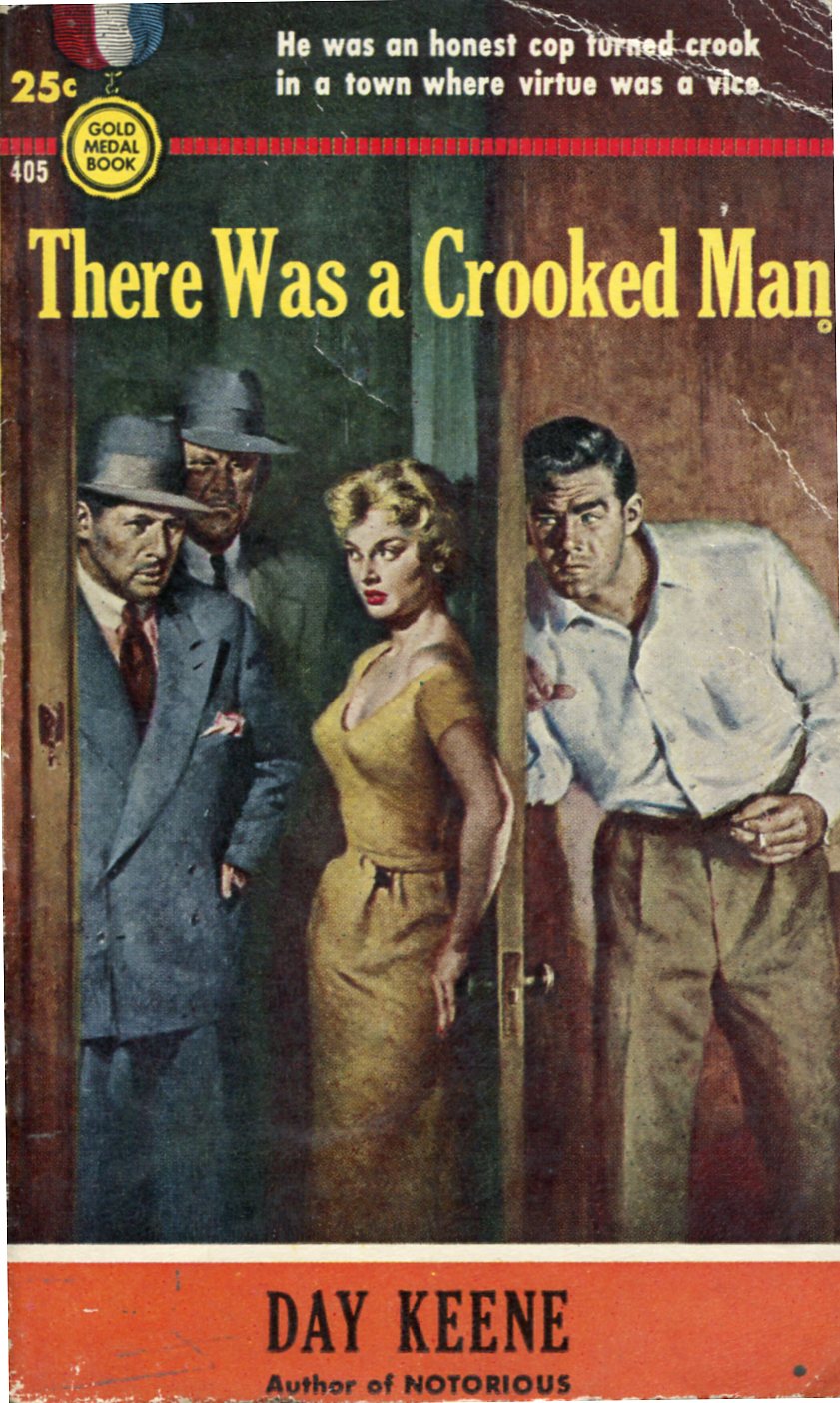


Day Keene was amazingly prolific, churning out one terrific crime thriller after another through the '50's. He had a very sly sense of humor and a gift for tight, fast pacing.

Joy House
Home is the Sailor
My Flesh is Sweet
If the Coffin Fits
Naked Fury
Sleep with the Devil
Bring Him Back Dead
It's a Sin to Kill


Lionel White wrote almost forty books, mostly for Gold Medal, many of them masterful examples of the "caper novel". Clean Break was the basis for the terrific early Kubrick movie, The Killing.

To Find a Killer
Clean Break
The Money Trap
Death Takes the Bus


Later in his career, Charles Willeford would create Miami P.I. Hoke Mosley, but his early non-series novels were pure psycho-noir at its bleakest, funniest, and most disturbing. A true indiviualist with little regard for the social constraints of his time, Willeford once said "Just tell the truth, and they'll accuse you of black humor." Black Mass of Brother Springer, especially, is worth seeking out. He's a personal favorite of mine.

The Woman Chaser
Pick-Up
Wild Wives
High Priest of California
Black Mass of Brother Springer (aka, Honey Gal)
Cockfighter
The Burnt-Orange Heresy
The Whip Hand


Peter Rabe: He wrote with clean style, and a voice that still seems fresh today. The best thing about Rabe was that he never wrote to formula: with any book of his you pick up, you never know what you're going to get. The only certainty is that it will be unpredictable and highly entertaining. One of the most original of the Gold Medal boys. Some of his work has appeared again in recent years, thanks to Stark House and Hard Case Crime.

Stop This Man!
A House in Naples
Kill the Boss Goodbye
A Shroud for Jesso
Murder Me for Nickels
The Box
Benny Muscles in
Anatomy of a Killer


Robert Edmond Altar is noteworthy because of the ‘strange factor’. Bizarro characters and an almost Southern Gothic flavor of psycho noir. Black Lizard reprinted them in the mid-80's. Good luck finding them now.

Carny Kill
Swamp Sister


Dan J. Marlowe came to the world of writing fiction late in his life, but in a short period of time managed to hit impressive numbers—both in the number of quality books he wrote and in number of sales, usually for Gold Medal Books. “The Name of the Game is Death” is considered one of the greatest noirs of all time.

The Name of the Game is Death
The Vengeance Man
Never Live Twice


Fredric Brown is known primarily as a science-fiction writer, but in the ‘50’s he wrote a handful of very highly-regarded noirs that were experimental in nature and existential in philosophy.

The Fabulous Clipjoint
The Screaming Mimi
The Far Cry
The Lenient Beast
Here Comes a Candle


They called Harry Whittington the "King of the Paperbacks", and with good reason. The guy wrote something like 180 books in about ten years, almost all of them distinctive for having as a protagonist a 'decent fella' on the run and facing overwhelming odds.

A Night For Screaming
The Devil Wears Wings
Web of Murder
Any Woman He Wanted
You'll Die Next


Chester Himes was the first black writer to make real headway in the genre with his tight and tough novels about Coffin Ed Johnson and Gravedigger Jones. Hardboiled Harlem noir with a deft social conscience. Great stuff.

If He Hollers, Let Him Go
The End of the Primitive
The Real Cool Killers
Cotton Comes to Harlem


Jim Thompson is the Golden Boy of Psycho Noir, though the last few years have seen a strange critical backlash against his work. It's true that he wasn't as consistent a writer as some of his contemporaries, but when Thompson was on his game, no one-- absolutely no one-- could touch him. His books capture better than any one else’s the world of the sociopath faced with obstacles he’ll stop at nothing to overcome, and the inevitable spiral out of control. His novels were bleakly comedic sometimes, always weird, and even the mediocre ones were never boring.

Now and On Earth
Heed the Thunder
Nothing More Than Murder
The Killer Inside Me
Cropper’s Cabin
The Criminal
Bad Boy
The Alcoholics
A Swell-Looking Babe
The Grifters
Savage Night
Recoil
The Golden Gizmo
A Hell of a Woman
The Nothing Man
After Dark, My Sweet
The Kill-Off
The Getaway
Wild Town
Pop. 1280

Next Wednesday, more great talent from the '50's...
Part Five

Saturday, July 16, 2011

And the winners are...

Okay, times up, pencils down.

Thanks everyone who played, I appreciate it. Some of you have really kick-ass taste in music-- there were more than a few sleazy noir songs I'd never heard before, so... thanks for that.

Winners were selected totally at random from little ripped up pieces of paper, pulled out of a bowl by my wife.

And the first winner is...

Benjamin Sobieck. His song of choice: Heaven's Toll, by Ramsay Midwood. Cool song, Benjamin. Let me know your mailing address (either in a comment here, or you can e-mail it to me at heathlowrance@gmail.com, or honestly whatever way is easiest for you. I appreciate your support!

Second winner:
Al Leverone. Al chose Whitewash, by Buckethead. Al, I think I already have your e-mail, but send it just in case, okay? And thanks!

And finally, the third winner:
Bolen Steiner.
Bolen is a Nine Inch Nails fan, and chose Something I Can Never Have.
Let me know what your mailing address is, Bolen, and thanks a lot for taking part in my little contest.

Everyone else: thanks for sharing your musical tastes with me, it was fun and enlightening.

Thursday, July 14, 2011

Stephen King, and why I love him


I really like this quote from Stephen King, because it sums up pretty nicely how I feel about the dreaded "doorstop thriller":

"So many of the 400-pagers are disposable... When I see books by some of the suspense writers that are popular now, I think: "These are basically books for people who don't want to read at all." It just kind of passes through the system. It's like some kind of fast-food treat that takes the express right from your mouth to your bowels, without ever stopping to nourish any part of you."

There are exceptions, of course, but I think for the most part that's spot on.

But King himself writes monstrously long books, doesn't he? Ah, a quandary.

The things I DON'T like about Stephen King: His books are, indeed, waaaay too long, usually. And he writes too goddamn many of them. I can't keep up. In fact, I'm a good DECADE behind.

The things I LOVE about Stephen King: nobody, and I mean NOBODY, writes better or more believable characters. That's King's gift to the world, and that's why he'll be remembered 100, 200 years from now.

Also, the man is a brilliant short story writer. As behind as I am on his novels, I never miss a short story collection from him. If you don't believe me, read Everything's Eventual and see for yourself. It's a collection by a man at the top of his form.

Stephen King's enthusiasm for writing and for reading (he's still a big ole' fanboy himself) are infectious. Long live the King.

Speedloader, from Snubnose Press


The good folks over at Spinetingler Magazine have offered up something new: Snubnose Press, an imprint designed for short story collections in e-book format. And that’s very cool indeed.
If their first outing, Speedloader, is any indication, you’d be wise to keep your eye on Snubnose. This is six stories right out of Hell, featuring writers who know their business and don’t pull their punches. It’s very hard to disturb me as a reader, but a couple of the selections here had me squirming uncomfortably. So, you know… well-done, mates.
The incomparable Nigel Bird opens the collection with the gripping “You Dirty Rat”, a WWI-era tale of revenge that manages to be beautifully layered and thrilling at the same time. I’ve not seen Bird take a misstep yet.
“Plastic Soldiers”, by W.D. County, is an engrossingly disturbing story about a boy faced with the evil of monstrous adults, and forced to take a stand to save his own life and the lives of some other kidnapped boys.
Mathew C. Funk’s “Cuffs”, is a chilly, nerve-wracking tale about a motorist accosted by a scary cop, and it’s fueled by a nice sense of paranoia and doubt.
“Mori Obscura”, by Nik Korpon, is another genuinely disturbing tale, involving an ex-junkie, a kidnapped child, and some very, very bad men…
“Herniated Roots”, from Richard Thomas, is a dark, somewhat depressing story about a “recovering” alcoholic trying to keep his life together, until he meets a beautiful woman who offers him either redemption… or total ruin.
And finally the awesome Jonathan Woods gives us “Crash & Burn”, a wildly unpredictable story about corrupt Mexican drug cops, a slighted woman, a raped Mexican official out for revenge, and… the vice president of the United States. Written with the usual Woods flair and black humor.
So, a solid collection, and a nice mix of writers I’m familiar with and ones I’d never read before. This is another one that’s a steal at .99 on the Kindle.
Very much looking forward to Snubnose re-loading.

Drunk on the Moon, by Paul Brazill


Roman Dalton doesn’t WANT to kill people. It’s just in his blood. See, three times a month he becomes stricken with a curse that transforms him from an ex-cop turned P.I. into a blood-thirsty werewolf. And it’s a good thing, too, considering that Dalton’s seedy underworld is infested with all manner of gangster zombies, lizard-men and other creatures of the night. It’s good to have a leg up in this crazy world…

A werewolf/private dick… if you’re like me, you’re thinking, “Damnit, why didn’t I think of that?” Well, you’re too late, man, because Paul Brazill already managed to sift through our collective unconscious and pluck this gem of an idea out. And that’s ALSO a good thing, because he manages to do something with it that most of us wouldn’t be able to. He saves it from becoming corny or annoying or trite by making Roman Dalton a genuinely interesting character, surrounded by an equally interesting supporting cast.

Drunk on the Moon, the first installment in a promised series of stories about Roman, is an oddly fragmented, episodic thing, designed to jangle your nerves a bit and upset your expectations.

Throughout, Paul Brazill gives us the flavorful language and keen observations about surroundings for which he’s become so well-regarded, and the violence, when it happens, is sudden and unexpected and over before you can blink. Again, that’s Brazill messing with your expectations about werewolf stories.

Future stories about Roman the werewolf P.I. will be written by a wide assortment of writers, all onboard to see what they can do with Brazill’s vision, so I imagine we’re going to see some amazingly varied approaches. But there’s no question that Brazill has set the bar high with Drunk on the Moon…
.99 cents on the Kindle. A ferocious bargain.

Wednesday, July 13, 2011

Hardboiled/Noir Writers Part 3

Part One here.
Part Two here.


The late ‘30’s and the ‘40’s didn’t offer much new in the hardboiled/noir world. There were plenty of solid writers, but there wasn’t much fresh on the market and it seemed that the Golden Age of creativity in the genre was over.
Not that the ‘40’s were completely devoid of anything noteworthy-- Jonathan Latimer wrote a book that really shook things up dramatically. He’s mostly remembered now for his more comic-oriented crime novels, but in 1941 he wrote what many consider to be one of the most brutal hard-boiled novels of all time, the hard-to-find Solomon’s Vineyard. This novel was censored and decried and condemned, and the unexpurgated version never saw print until the 1980’s.
--Solomon’s Vineyard (aka The Fifth Grave)

But for the most part it was rough-going for readers of hardboiled/noir. The steady decline of the pulp magazine market didn’t help things. It had been going downhill for some time. The interest in crime stories that dominated the magazine stands in the ‘20’s gave way in the ‘30’s to action heroes like Doc Savage, The Shadow, and the Spider. And by the end of the decade, even those were suffering from poor sales.
But it was the emergence of this new thing called ‘paperback books’ that really sounded the death knell of the pulp magazine. New printing technology made binding books between stiff covers affordable. At first, publishers concentrated on ‘classic lit’ or mainstream fiction, but it didn’t take long for some savvy publishers to realize the true potential of the paperback original.
It took awhile for everything to gel, but right from the start the idea of a book printed in a cheap, easy to handle format was a huge success. During World War II, paperback books were popular with soldiers—they were convenient, could fit easily in a pocket or knapsack, and were considerably more resilient than a magazine. The industry continued to grow after the war, when the idea of paperback originals first took hold.
By the early 1950’s, publishers like Gold Medal Books had staked out a considerable territory and in the process created a whole new type of publishing. It was the beginning of the second Golden Age of hardboiled/noir.

The paperback originals had to have solid plots, lots of action, some sex (though not as much as the covers suggested), and pitch-perfect pacing. No time for character introspection that lasted more than a paragraph. No time for lengthy detailed descriptions of places and things. The best writers of the paperback originals were masters at sketching images in the reader’s minds, giving them the essentials and keeping the story rolling along like a sleek roadster.

It was a time of transition for the writers trying to make a buck, and some of them adjusted to the cross-over better than others.


One of the most successful of these was Cornell Woolrich. He had a solid career in the pulps, and many of his stories were translated for the big screen. When pulps gave way to paperbacks, he shifted gears and enjoyed renewed popularity as both Woolrich and William Irish.
Woolrich didn’t write in that lean, spare style that we’ve come to associate with noir and hard-boiled; his prose was rich and full, brimming over sometimes with melodrama that, to a modern reader, can be occasionally tiresome. But for all that, not too many writers could match him for ratcheting up tension, creating almost palpable dread, and making sure the reader kept those pages turning to see what awful thing was going to happen next.
He was also one of the first writers in the genre to give us stories from a female point of view. In fact, most of his best stories are tales of women driven to murder to protect their honor or to avenge the death of a loved one. Most notably, his so-called “Black Trilogy”.
There’s been speculation that Woolrich was a closest homosexual, and that he suffered from depression and bouts of alcohol-fueled self-loathing. Reading his work, you wouldn’t find these speculations surprising. The world he writes about is a dark, untrustworthy place. Although his frantic wordiness can be rough going (a little Woolrich goes a long way), he is essential noir. Try one or two of these:
--The Bride Wore Black
--The Black Curtain
--Phantom Lady
--Black Alibi
--The Black Angel
--Black Path of Fear
--The Night Has a Thousand Eyes
--Rendezvous in Black
--I Married a Dead Man
--Savage Bride
--Fright


David Goodis was the other notable writer who shifted well from pulp to paperback, although many critics think that his work suffered throughout the fifties. It’s true that, as early as 1947, Goodis seemed destined for mainstream success with his novel Retreat from Oblivion. But by the beginning of the new decade it seems that, for some reason, he opted for a sort of anonymousness by writing paperback originals and keeping a low public profile. Mainstream success didn’t elude him; he eluded it.
Some critics consider Goodis the true father of noir, usurping the role usually reserved for James M. Cain. He was certainly more consistently entertaining. To some degree, his subject matter reflected what we’ve come to believe about his own life. Goodis wrote about the losers, men who had fallen from grace due to circumstance or their own poor choices. His novels were dark and pessimistic and grim, without an ounce of humor. Bleak stuff, and highly recommended for a serious dose of noir.
--Retreat from Oblivion
--Dark Passage
--Nightfall
--Of Missing Persons
--Cassidy’s Girl
--Street of the Lost
--The Burglar
--Moon in the Gutter
--The Wounded and the Slain
--Black Friday
--Street of No Return
--Shoot the Piano Player (aka, Down There)


So the death of the pulps didn’t always have to mean the end of careers. Several other writers of varying talent made the switch, while still writing for the handful of pulps that still existed. However, by the mid-fifties a whole new crop of amazing young writers had premiered, and the face of crime fiction altered, shifted subtly into a thing of more sophistication that the old pulp writers could ever have imagined.


Private Dicks


By far, the most popular writer in the genre in the 1950’s was Mickey Spillane.
Spillane was-- and still is-- a polarizing personality in crime fiction. Some have dismissed him as jingoistic, xenophobic, hateful. Entirely possible, but his ability to pull a reader in and keep him involved shouldn't be overlooked. Spillane was a master at giving the readers what they wanted, and was hugely important in the history of hardboiled. His novels about Mike Hammer were ultra-violent, misanthropic, and unapologetically nasty. As a protagonist, Hammer was a raging, hateful creature of vengeance, driven by some peculiar code of honor that only he seemed capable of abiding.
I, the Jury
My Gun is Quick
Vengeance is Mine
One Lonely Night
The Big Kill
The Long Wait
Kiss Me, Deadly

A whole slew of private detective heroes emerged in the wake of the Mickey Spillane phenomenon of the 1950’s, and even the ones who’d been around earlier enjoyed renewed success.


Brett Halliday’s series about Mike Shayne is noteworthy— first of all, there were tons of them. Halliday has been writing Shayne’s adventures all through the 1940’s, but the surge of interest in P.I. novels that came on the wake of Spillane’s success lent the series new life. While the plots were often interchangeable, they were all solid and remarkably well-written. As a character, Mike Shayne wasn’t given to too much introspection, and Halliday wasn’t big on social commentary—Shayne has been called the “generic private dick”. But for all that, the Mike Shayne novels were never boring. The movie Kiss Kiss Bang Bang was based loosely on Halliday’s novel “Bodies are Where You Find Them”.
Here’s a sampling:
Dividend on Death
Bodies are Where You Find Them
The Corpse Came Calling
Murder is My Business
She Woke to Darkness
Death Has Three Lives
Stranger in Town
Shoot the Works


In the part of town where the sun still shone, there were the light-hearted novels of Shell Scott, by Richard S. Prather. Scott was, in many ways, the ‘anti-Hammer’—funny, good-natured, and with an appreciative eye for the ladies. As a character, Shell Scott was a likeable rogue with an easy grin and a solid sense of humor, and his books are diverting and fun.
Case of the Vanishing Beauty
Everybody Had a Gun
Always Leave ‘em Dying
The Wailing Frail
Three’s a Shroud


Another writer who benefited in the wake of Spillane's success was Frank Kane. His series character Johnny Liddell first appeared in '47, and throughout the '50's remained steadfastly popular. As Bill Crider noted, if it's a Frank Kane novel, it's likely to be a "competent, straight-forward P.I. story". Kane wrote almost 30 novels about Liddell; here's just a sampling:
About Face
Bullet Proof
Poisons Unknown
Grave Danger
The Living End


However, the most significant writer of P.I. novels to emerge in the ‘50’s (sales notwithstanding) was Ross MacDonald. His books about Lew Archer came closer than anyone before him to perfecting the sub-genre and honing it to a razor-sharp edge. He’s regarded these days as the true heir to Chandler, keeping the torch lit for the lyrical hardboiled style. As the series progressed, Archer mellowed, and so did the books. But the early adventures were tough-minded and violent, all the while maintaining a curious sense of melancholy and insightfulness. I think he was actually better than Chandler. He was a more consistent writer, and the scope of his literary concerns was just as all-encompassing.
The Dark Tunnel
Trouble Follows Me
Blue City
The Three Roads
The Moving Target
The Drowning Pool
The Way Some People Die
The Ivory Grin
Meet Me at the Morgue
Find a Victim
The Name is Archer
The Barbarous Coast
The Doomsters
So the private eye novel was riding high; that didn’t mean there weren’t readers interested in the other side of the fence. The publishers of paperback originals were ready to give ‘em what they wanted, with a whole slew of immensely talented writers who were expert at mining the materials of crime, deceit, and avarice to bring out the leanest, meanest novels imaginable.

go to Part Four

Tuesday, July 12, 2011

Gun, by Ray Banks


• One of the great things about Kindle and e-readers in general: the return of the novella. If no one else has already predicted this, I’ll do the honors. Novellas and short novels are coming back. And thank Christ for that, maybe the days of over-blown doorstop thrillers are nearing an end, eh? One can only hope.
• If Ray Banks novella, Gun, is any indication, there’s some seriously tight, noir-to-the-bone stuff to read. Although, to be honest, most of it won’t come anywhere NEAR Banks’ quality. He’s one of our finest writers, and all his formidable skills are on display with Gun.
• The story: our young hero, Richie, has a simple enough task: go to Florida Al’s place, pick up the gun his boss wants, and bring it back. Piece a’piss, right? If you answered “yes” to that question, then you clearly haven’t read enough modern noir. I want to avoid spoilers here, but I can safely tell you that Richie is in for one seriously shit day.
• One of my favorite things about Banks is his knack for great dialogue. Crime writers in England, Scotland and Ireland have a big advantage over us Americans in that their vernacular is so colorful and entertaining. Everyone’s always saying “Oh, aye,” and talking about “chining” someone or calling other people “lad”… let’s face it, Brit criminals talk cooler than American ones. And Banks knows how to pepper the dialogue with this great language without it ever becoming incomprehensible.
• If you haven’t read Ray Banks yet (and honestly, why haven’t you?) Gun is a good place to start. Short, hard, and brilliantly written. And it’s only 99 cents on the Kindle.